






Independently audited since 2020.
/ software localization /
Software localization in step with every release
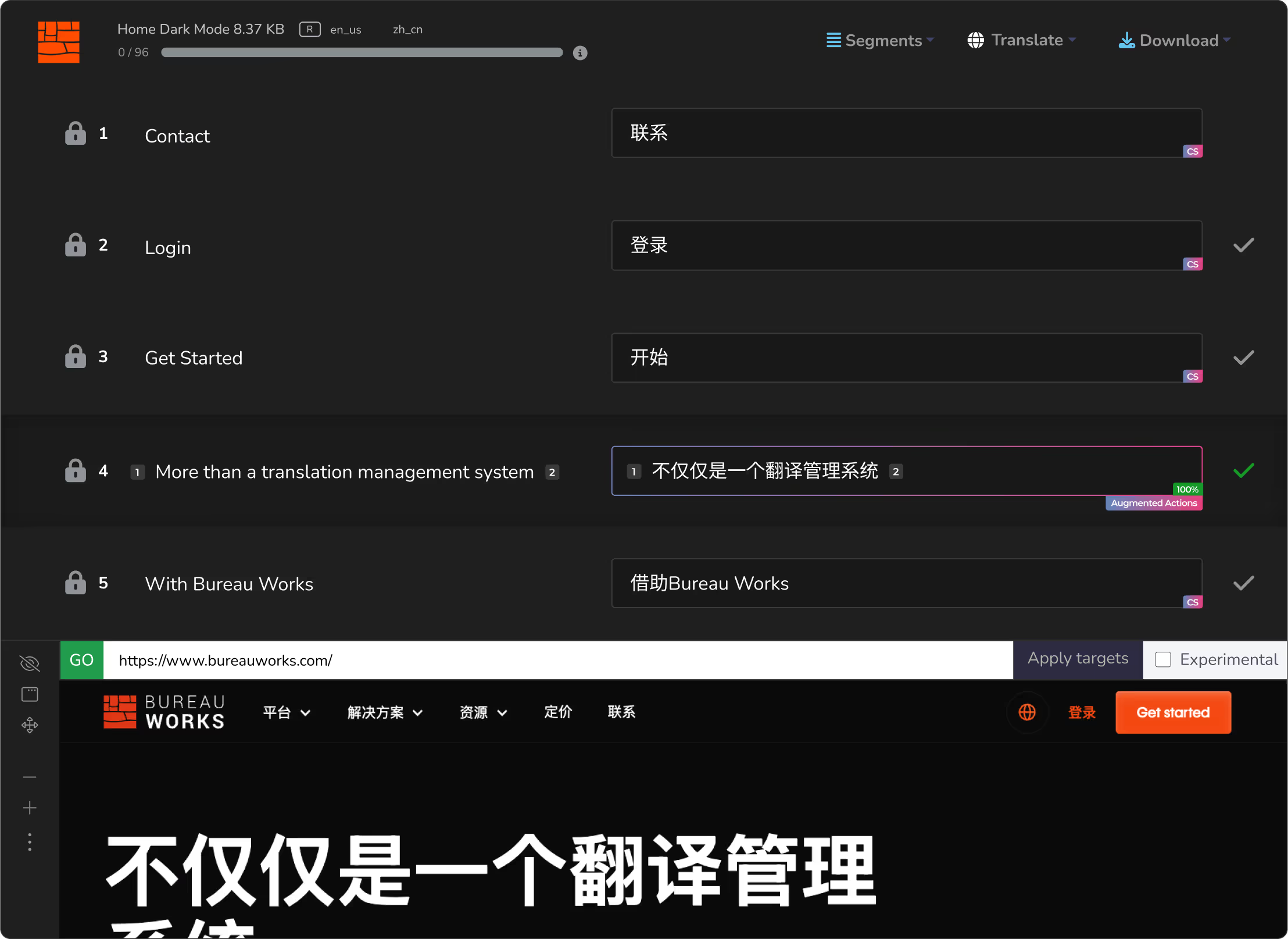
Strings come in from your repo on their own and go back translated. Your linguists work with your translation memory and glossary. Smells, the wxrks check for meaning, scores every segment, and your threshold decides what needs review.
See it with your own strings- SOC 2 Type 2 independently audited since 2020
- G2 Leader for translation management systems
- 19 integrations including GitHub and GitLab
/ teams that run translation on wxrks /
/ the right word for your product /
Your product’s words, in every string
Spanish has two words for “file.” In your app it’s “archivo.” In a case management tool it might be “expediente.” A machine translation engine picks one and moves on.
Context Sensitivity is how wxrks builds a suggestion. It gathers your memory matches, glossary terms, instructions, and similar past work for each string, ranks them, and lets the AI model decide from them. Autocomplete offers your terms as you type and never offers a forbidden one.
part 02every segment
Release-ready strings, by your threshold
Your QA catches a broken placeholder. It won’t catch a string that now says the opposite. Smells reads every segment against your glossary, memory, and instructions, and gives it a Confidence Score from 0 to 100.
Clean sentences go straight through
A segment that scores above your threshold is locked for release, so nobody spends time on it.
Small slips fixed for you
Tags, punctuation, and spacing are corrected automatically.
Judgment calls go to a person
When meaning, terms, or tone is in doubt, the segment goes to the reviewer you named.
Weight what matters to your product.
Smells Scoring lets you weight each kind of problem, with presets for wxrks, MQM-style, or Strict. Preview the impact on your last 90 days at no AI cost.
Your repo and pipeline, connected
ReposGitHub and GitLab connectors
New and changed strings arrive in wxrks on their own.
Code and agentsAPI, webhooks, CLI, and MCP
Start projects from code. Webhooks are signed and retried, and the CLI runs workflows from code and AI agents.
FormatsSoftware strings, XML, and XLIFF
Software strings get a live preview, and XML and XLIFF preview through a stylesheet.
ChangesOnly changed sentences go back
When the source changes mid-project, Update Source sends back only the sentences that changed.
/ your models, your data /
Any model you choose, with your knowledge base
Choose the model for each job, from OpenAI, Anthropic, Google, Groq, Cerebras, or your own keys. Each product unit can run its own.
Models in wxrks are stateless, so they keep nothing between requests. Your memories, glossaries, and instructions stay in your account, and no customer content trains any model.
/ security /
Security your reviewers can check
Your content stays in the region you choose, opens only for the people you let in, and never trains an AI model. Send us your security questionnaire.
AWS in the US or the EU (Ireland), chosen at signup on every plan.
Models keep nothing between requests, and no customer content trains any model. It’s written into our data processing agreement.
What wxrks learns lives in your memories, glossaries, and instructions, never in a model.
SAML 2.0 with any provider, including Okta, OneLogin, and Microsoft Entra ID. Require it for the whole account.
SCIM adds and removes people as your directory changes. Set multi-factor sign-in, session length, and password rules.
Roles and permission groups, and any permission can be turned off for one person.
Files are stored apart for each account, every access is logged, and every connection uses TLS 1.2 or higher.
/ who uses it /
One platform for localization and engineering
Set the memory, glossary, model, and threshold for each product, and see progress by language and project.
Connect the repo once, and let connectors, the API, and the CLI handle strings from then on.
Questions software teams ask us
Does wxrks translate our software for us?
wxrks is the platform. The translating is done by your localization team, your agencies, or freelance linguists, each starting from AI suggestions built on your memory and glossary. Need more linguists? The wxrks Marketplace lists agencies and translators who already work in wxrks.
Which formats does wxrks handle?
Software strings, XML and XLIFF, documents, websites, and video subtitles. Software strings get a live preview, and Figma preview marks text that overflows the design.
How does wxrks fit our release cycle?
GitHub and GitLab connectors bring new and changed strings in on their own. If the source changes mid-project, Update Source sends back only the changed sentences.
Which AI models can we use?
OpenAI, Anthropic, Google, Groq, Cerebras, or your own keys. Use a different model per unit if you like.
Can we move our existing memories?
Yes, at any size, and glossaries too. Then run a 30-day proof of concept with your own linguists before you decide.