

Segments and context can work together, so the conflict isn't technical. It's trust, and trust here is certainty. One segment at a time, a localization manager knows the price, the risk, and the result. Moving the memory from matching characters to matching meaning breaks the one to one their work is built on, and most of that certainty goes with it. The work is to turn the uncertainty back into certainty with controls. Rodrigo argues for making the move.
What is the myth?That more context is the big change. The bigger change is finding approved work by meaning, not by characters.
What does a safe move look like?One where the team's jobs stay safe and the manager can show the gain internally. That's how CCEP made the move.
There is a big conversation today in localization tech. On one side, segments, in a one-to-one comparison between source and target, with all the advantages we know. You lock the segments already approved and review just the new ones. On the other side, the new model, with more context, more segments grouped together, and better quality. And the conversation is that you have to pick which world you want.
Technically, you don't have to pick. You can send the AI model the important context and still reuse the segments your reviewers already approved.
I agree there is no technical conflict. The conflict I see is about trust.
The lack of trust is a lack of certainty.
Today a localization manager knows the price, the risk, and the result. In the new world, not yet. Turning that uncertainty into certainty is the work.
I see two reasons a localization manager could have a hard time making this move.
When I put myself in the localization manager's shoes, I'm not supporting that view. I'm forcing myself to think from their side, because they are the ones who have to trust the change.
I don't support staying with segments. I support that we have to migrate to this new world.
1. Why a localization manager holds on to one segment at a time
Segments, edit distance, MQM, and the rest of the localization framework were a response. Edit distance measures how much a reviewer changes a suggestion. MQM is a shared way to count and grade translation errors. Together they helped the industry raise productivity and reduce cost and risk at scale.
They also gave the localization manager a problem they can solve one segment at a time. It fits a workflow anyone can follow. It gets translated, reviewed, approved, and stored. You can count it, price it, and report on it. When a stakeholder asks what happened to a sentence, you can show them. That is how quality management works on most teams today, and it works.
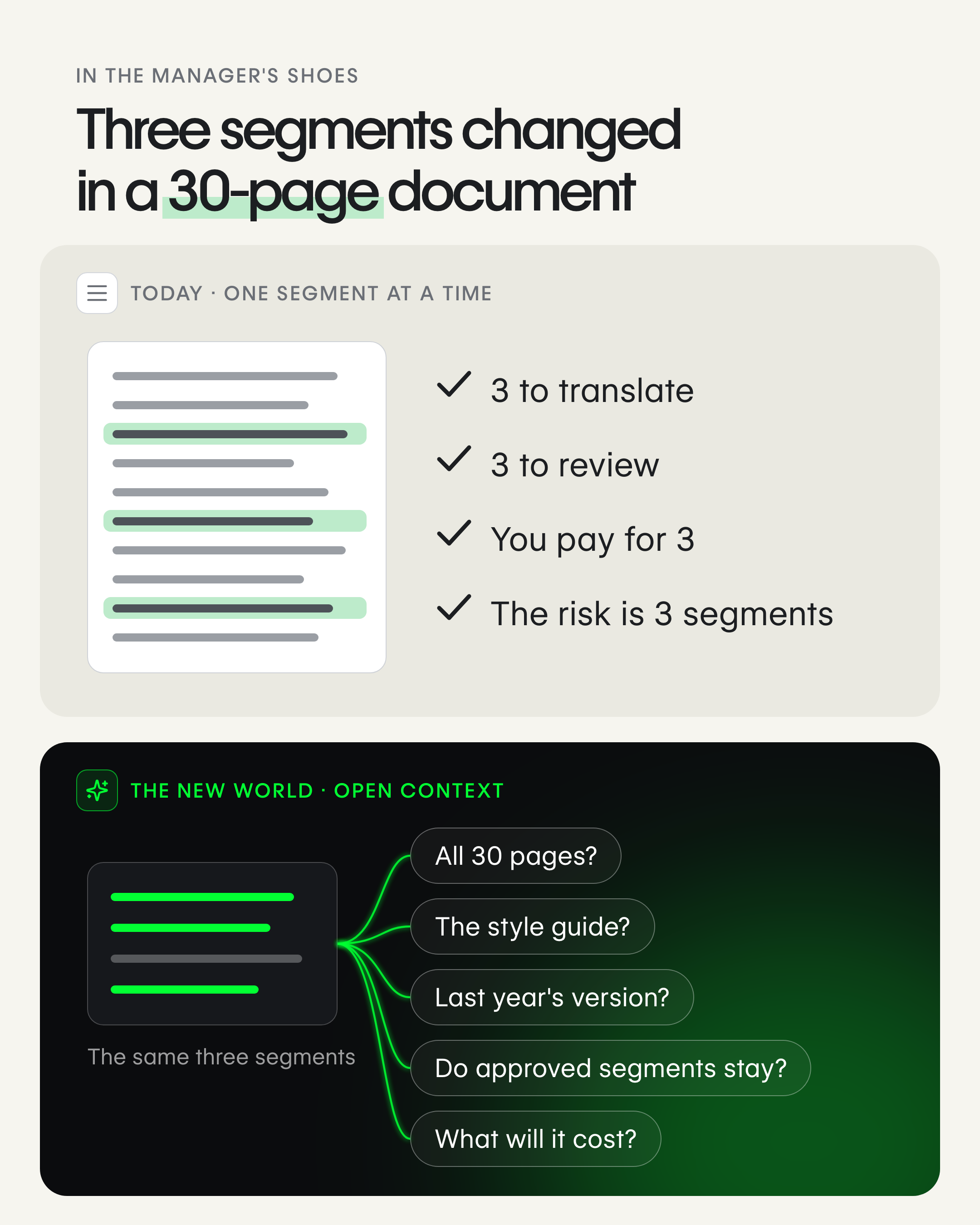
Take a 30-page document your team translated last year. Three segments changed. One segment at a time, you know what happens. Three get translated and three get reviewed. You pay for three, and the risk is three segments. It's predictable.
With open context, the same three segments open a whole other world. What context do I put in to fix them? All 30 pages, the style guide, last year's version? Will the segments we already approved stay exactly as they were? What will it cost? And how do I measure that all of it makes the translation better, and not just different?
The job itself changes. I was someone dealing with workflows, managing assets, and delivering assets. Now I'm working on taxonomy, content hierarchy, and many topics connected to language and content.
Some people call this orchestration. I think it goes deeper. In orchestration, your musicians are all still playing. Here you remove the musicians and replace the entire place.
That is much harder to sell to a localization manager, and much harder to trust. It raises an honest question, too. If everything moves to context, why keep any localization technology at all? Why not send the content to the newest model and let it do the thing?
I see it as a range. On one side, translation that is fully automated, with none of the tools teams use today. On the other, translation done fully by people. Each step toward the automated side removes something our industry was built on. So the manager has to trust that the new way works, that it keeps their job alive, and that it won't break the workflows they run right now.
2. Why moving the memory to meaning is hard for a localization manager
My second point matters more to me. A translation memory, your library of approved past translations, finds matches by comparing characters, not meaning. The comparison is called a fuzzy match, a percentage of how much of the old sentence lines up with the new one.
So an approved translation can sit in your memory and never come up, only because it was written differently. If a sentence changed 50%, in many cases the fuzzy match won't even offer it.
Take "Talk to our sales team." and "Speak with someone in sales." They mean the same thing. About a quarter of their characters line up, far too few for a fuzzy match to show. A reviewer approved that idea last year, and this year the translator starts from zero.
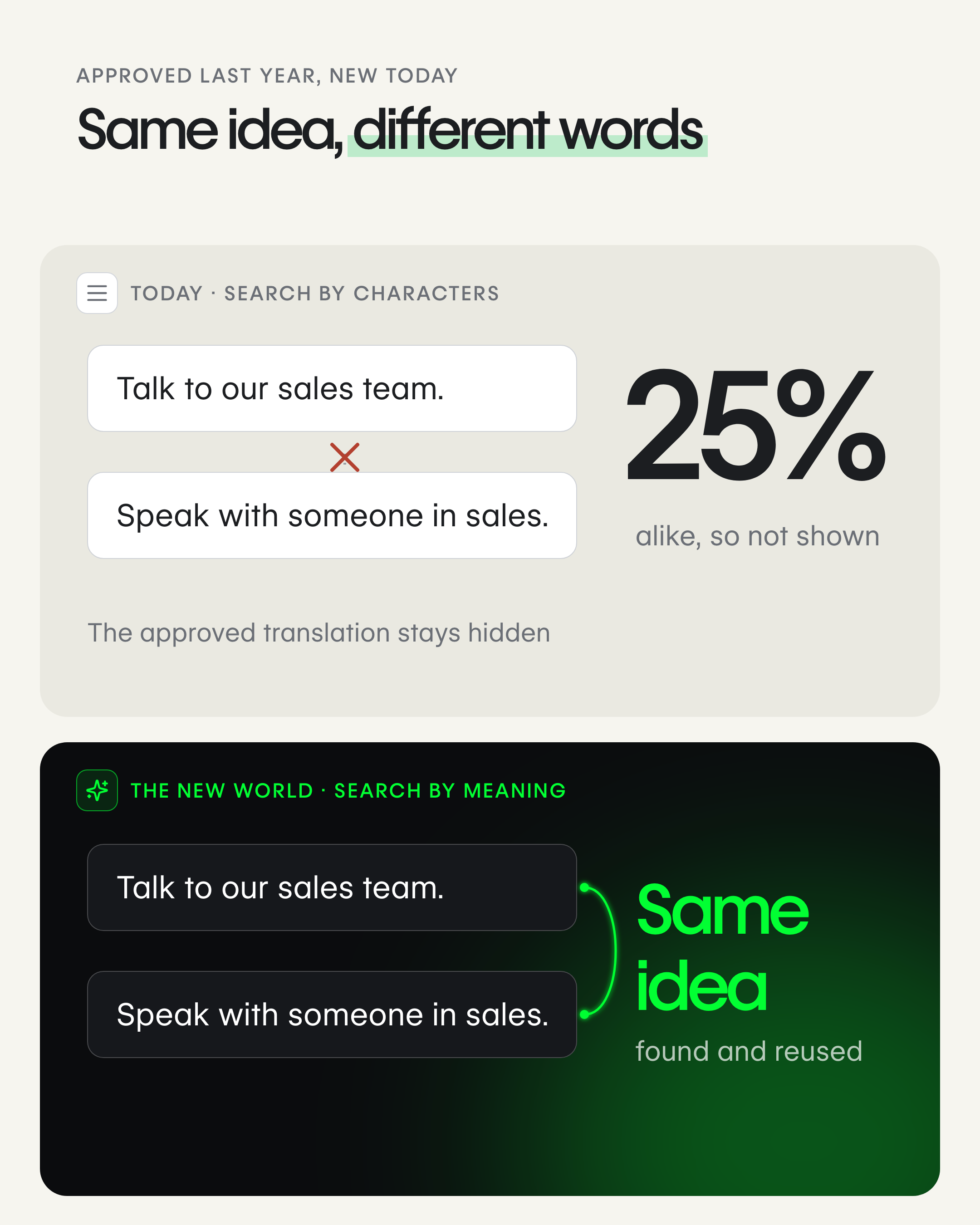
Search by meaning works differently. Each sentence is stored as a list of numbers that stands for what it means, a method researchers call vector semantics. Sentences that mean the same thing land close together, whatever words they use. So a new sentence finds your approved work by what it says.
Gabriel's deck on vectors shows the difference with two sentences that say the same thing.
| Stored as text | Stored by meaning | |
|---|---|---|
| John has gone to the store. | The words, letter by letter | [0.12, -0.94, 0.43, 0.01, 0.63] |
| John went to the supermarket. | The words, letter by letter | [0.12, -0.93, 0.42, 0.01, 0.63] |
| What a search sees | Two different sentences | The same idea |
The numbers are a simplified example from the deck. Real vectors are much longer, and sentences with close meanings still get close numbers.
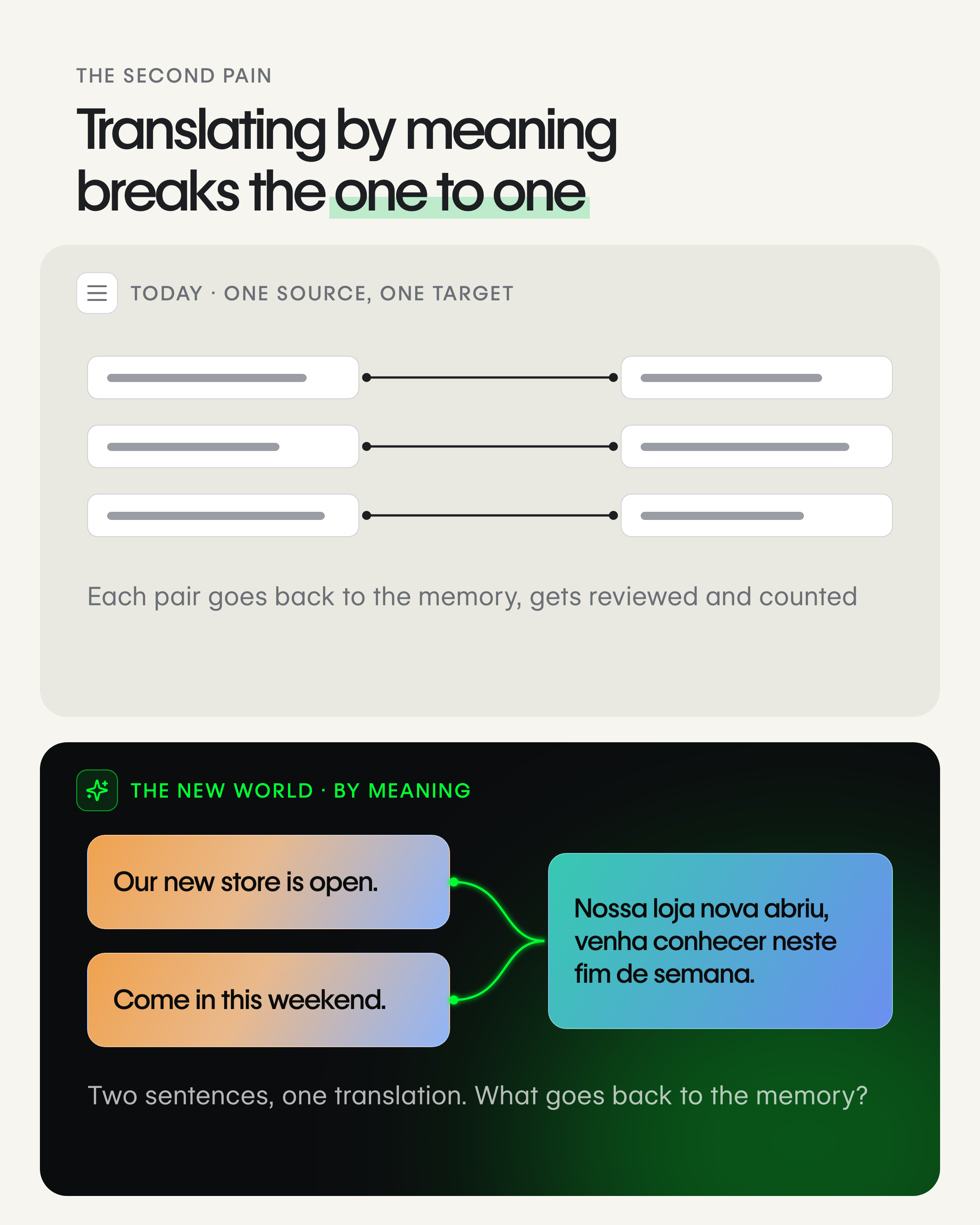
Here is the hard part, from the same seat. A translation memory is built on pairs, one source sentence for one target sentence. Translate by meaning, and that one to one breaks. "Our new store is open. Come in this weekend." can become one Portuguese sentence, "Nossa loja nova abriu, venha conhecer neste fim de semana." So what goes back to the memory? What does the reviewer compare? How do you count it and pay for it?
“Segments are great… but they’re also a prison.”
Gabriel Fairman, CEO of wxrksSo the myth, in my opinion, is not about more context or less context. It's about moving from a syntactic way of storing and searching, by characters, to a semantic way, by meaning. Once meaning is at the center, you reuse far more of the content your team already approved and paid for.
Our CEO, Gabriel Fairman, made the same point in his talk on why segments hold us back. Segments, he said, are "built for syntax-driven operations, not for semantic-driven operations."
What it looks like in practice
Free-Flow is our editor built on vectors. You work on the whole document, and it reads your glossaries and past translations by meaning instead of matching words.
Free-Flow doesn't replace our segment editor. As its deck puts it, Free-Flow is an alternative for a different kind of use case and purpose.
| Segment editor | Free-Flow | |
|---|---|---|
| Best for | Software, documentation, and work that must be predictable | Transcreation, deep adaptation, repurposing, and new content |
| Memory and glossary | Found by matching characters | Found by meaning |
| Source and target | One sentence for one sentence | No one-to-one rule, you can even start from the target |
| The text | Split into segments | The whole document |
The Free Flow Editor by Gabriel Fairman
Free-Flow was a finalist at the Process Innovation Challenge
Henrique Cabral, our CTO, presented it on stage at LocWorld.
Gabriel's deck, Findings and Theories in a Push for a Fully Vectorized Translation Environment, lays out the research behind it.
Once you have vectors, you start to play with more meaningful alerts. Articulated Suggestions, the continuation of Free-Flow, is that next step. Gabriel presented it at the Process Innovation Challenge at LocWorld 54. It looks at the why behind each edit, not only the edit. A translator replaces "cutting-edge" with "advanced" to sound less bold, and it suggests "several" instead of "various" to keep the same tone.
Measuring doesn't have to change. You can still measure each segment by how much a reviewer edits it. In The Edit Distance Report, across 27 million segments, suggestions built from each team's own approved translations and glossary, what we call Context Sensitivity, needed 47% less editing than machine translation. That's a number you can take to a stakeholder.
The two worlds, side by side
Here are the topics from this article, as a localization manager sees them today and in the new world, each one marked certain or uncertain.
| TodayOne segment at a time | The new worldMeaning at the center | |
|---|---|---|
| Price | Certain Predictable. Three segments changed, you pay for three. | Uncertain How much context goes in, and what will it cost? |
| Risk | Certain You can count it, three segments. | Uncertain Will the segments you already approved stay the same? Nobody knows yet. |
| Context for the AI | Certain The segment, maybe a few neighbors. | Uncertain More of it. But how much? The whole document? The style guide? Past versions? |
| Finding approved work | Certain By matching characters. 25% alike is not shown. | Advantage By meaning. The same idea is found in other words. |
| Source and target | Certain One sentence for one sentence, easy to store and count. | Uncertain Two sentences can become one. What goes back to the memory? |
| Room for transcreation | Little. One answer box per segment. | Advantage The clearest advantage. Rewrite, merge, reorder, even start from the target. |
| Review | Certain Each pair, side by side. | Uncertain A whole passage, compared against goals. Great for people who love meaning, and more abstract. |
| Measuring | Certain Edit distance per segment, a unit you can measure and report. | Uncertain If you keep the segment, how much better did it get? Was the move worth it? |
| The manager's job | Certain Workflows, assets, and deliveries. Concrete things you can touch. | Uncertain Taxonomy, content hierarchy, and language. More abstract, and harder to measure. |
Look at the pattern. Today is certain almost everywhere. The new world is uncertain almost everywhere, with one clear advantage, the room it gives the people who write. The lack of trust is a lack of certainty.
So the work is to turn that uncertainty into certainty. That's what we build, controls that give the localization manager something to set, measure, and show, even in a realm that is more abstract.
A move the localization team can sell
For me, the question isn't only what's possible to do. It's what's possible to do inside the organization where our client works.
So the goal is a framework that makes a localization manager feel safe to migrate. Their job stays safe. They can sell the implementation internally and show it was good. And the move can take them to new heights.
That's how we worked with Coca-Cola Europacific Partners. We revamped the structure completely, and we kept giving a future to the people who trusted us. Elitza Dublewa-Servatius told the story at LocWorld56, from a pilot with about 100 colleagues to two years of approvals, with every complaint turned into a requirement. Watch her session.
Moving from one framework to another is an organizational change before it's a technical one. It has to protect the people who lead it.
See how Free-Flow finds your approved translations by meaning